Page Coal and Coke Company Storeis the most prominent historical site. The former company store was designed in 1914 by architect Alex B. Mahood. It is a two-story brick building, set on a stone foundation and is listed on the National Register of Historic Places.

Page Coal & Coke Company
By Buddy French
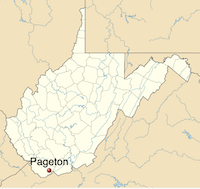
The Page Coal & Coke Company was located at Pageton, West Virginia and was
named after Louis R. Page. He was one of its three major shareholders, and the
company
was incorporated on March 5, 1903. The new company secured a lease
of 3,186
acres of coal that included both the Pocahontas No.3 and No.4 coal
seams. With the construction of a coal tipple complete, coal shipments began in
1904. By 1910, the company had built 500 coke ovens, although not all of them
were ever utilized at one time. In 1920, coal began being coked at the steel mills,
and the Pageton coke ovens were taken out of service and later removed. In their
place, a long row of new housing was constructed for coal miners and their
families. The new neighborhood was aptly named "Coke Row". A nethew coal
tipple replaced the old one in 1941 and over the ensuing years, mining
operation continued to grow. Employment peaked at 828 employees in 1948,
and the tipple was modernized in 1960.
The company store in Pageton was always the focal point of the community. The
store was built in 1914 and designed by well-known Bluefield, West Virginia
Alexandra Blount Mchood. It was more like a community center where you could
meet friends and catch up on the latest coal camp news. Kids gathering at the
company store often turned a simple soda into an evening of laughter and fun.
Pageton was truly a great place to live when growing up there during the booming
years of the coal industry. There was a strong sense of community among the
residents, and everyone knew each other. The surrounding mountains served
as a
playground where young boys would often spend the day exploring. Girls
enjoyed sleep overs with friends. Life in Pageton was simple yet fulfilling because
there was a strong connection to community life. Whether it was a gathering for
a community event or helping a neighbor in need, there was always a sense of
togetherness and shared purpose. Your author had a good friend and coworker
at the Gary company store who lived on Coke Row in Pageton. His name was
Luther Webb, and he was a giant of a man who was always jovial, smiling and so
dedicated to his family. In 1963, your author replaced the engine in Mr. Webb's
Panel truck while sitting in front of his house on Coke Row.
After being a company owned town for fifty-nine years, the Page Coal Coke
Company shut down its mining operations in 1963 and the property was acquired
by the Consolidation Coal Company. For the next several years, the new coal company
used the coal preparation plant to process coal that was mined at its other mining
locations in the county. By the 1980's, the Consolidation Coal had shuttered the Pageton
coal preparation plant, and it was torn down circa 1990.. The coal mines had been
the economic heart of the town, and many folks have lasting memories of the
hardworking miners who toiled to support their families. The friendships and
bonds formed in Pageton for those who grew up there have lasted a lifetime and
they will always cherish their time spent there and for those still living
there, it will
always be home.
Many thanks to Alex Schust and his book Billion Dollar Coalfield where more
information can be found on Pageton, West Virginia history.
I would also like to thank
my good friend Dr. Nolan Evans, PHD of Fort Worth,
Texas who graciously agreed to
proofread my story before publishing it.
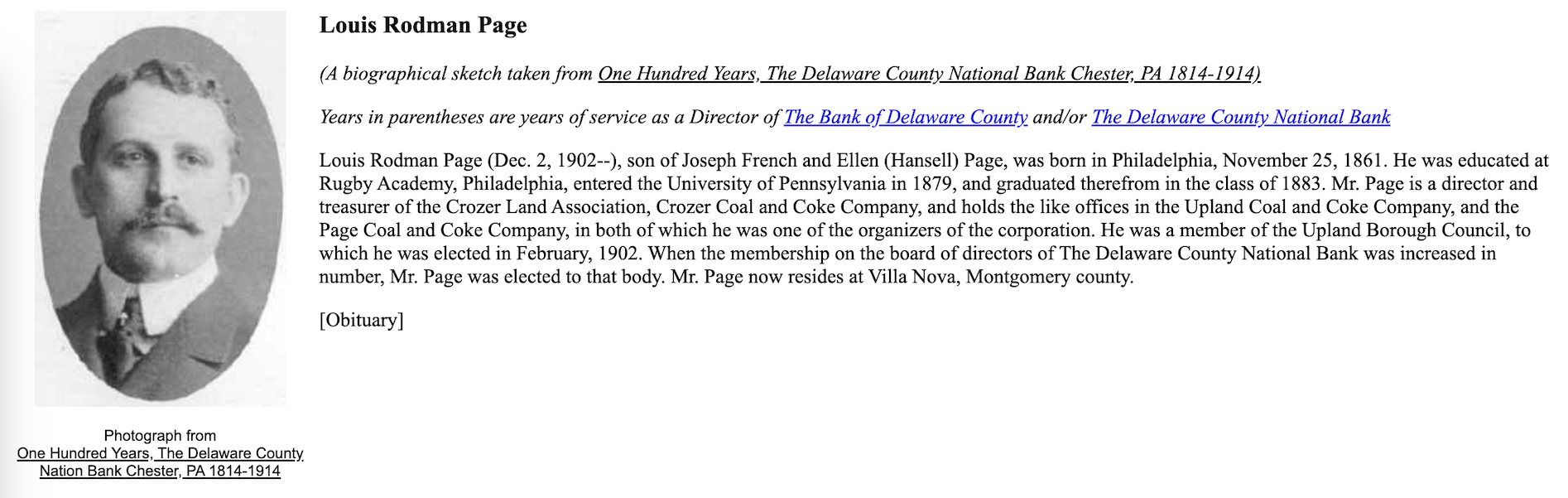
The Page Coal & Coke Company was located at Pageton, West Virginia and was
named after Louis Rodman Page.
PHILADELPHIA, Jan. 9, 1949 —L. Rodman Page, head of a coal firm and member of an old Philadelphia family, died today on his estate, Rodric Manor, in suburban Villanova.
Mr. Page retired two weeks ago as president of the Page Coal and Coke Company, but remained a director of the Corn Exchange National Bank. An alumnus of St. Paul's School and of Princeton University, class of 1912, he was active for many years as vice commander of the Crusaders of Pennsylvania, an Anti-New Deal organization.
Mr. Page was a member of the Racquet Club, Corinthian Yacht Club, Gulph Mills Golf Club, Military Order of Foreign Wars and the Princeton Club of New York.
His first wife; the former Katherine Kremer, was killed in a fall four years ago at Rodric Manor. He leaves his second wife, the former Janet Adamson of Chestnut Hill; two sons, Richard K. and L. Rodman Jr.; a sister, Mrs. John Shipley Dixon, and a brother,
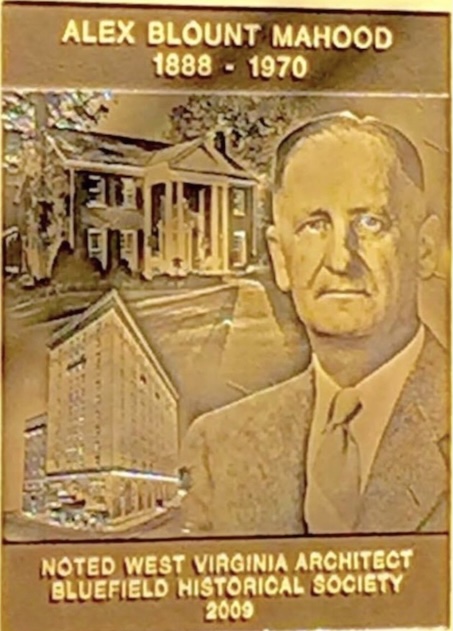
Alexander Blount Mahood (March 17, 1888 – December 25, 1970) was a prominent American architect based in Bluefield, West Virginia, known for his prolific work across southern West Virginia and his neoclassical designs.
Born in Lynchburg, Virginia, Mahood attended public schools before studying architecture at the prestigious École des Beaux-Arts in Paris, France. He returned from France in 1911 and began his career as a draftsman in Lynchburg before moving to Roanoke to work for other architectural firms.
In 1912, Mahood moved to Bluefield to open a branch office for the firm Miller & Mahood and to supervise the construction of the Law & Commerce Building, which was the largest office building in the growing city. He dissolved his partnership with Miller in 1914 and established his own private practice in Bluefield, which he maintained until his death in 1970. His son, A. B. Mahood Jr., later joined the firm as an associate.